
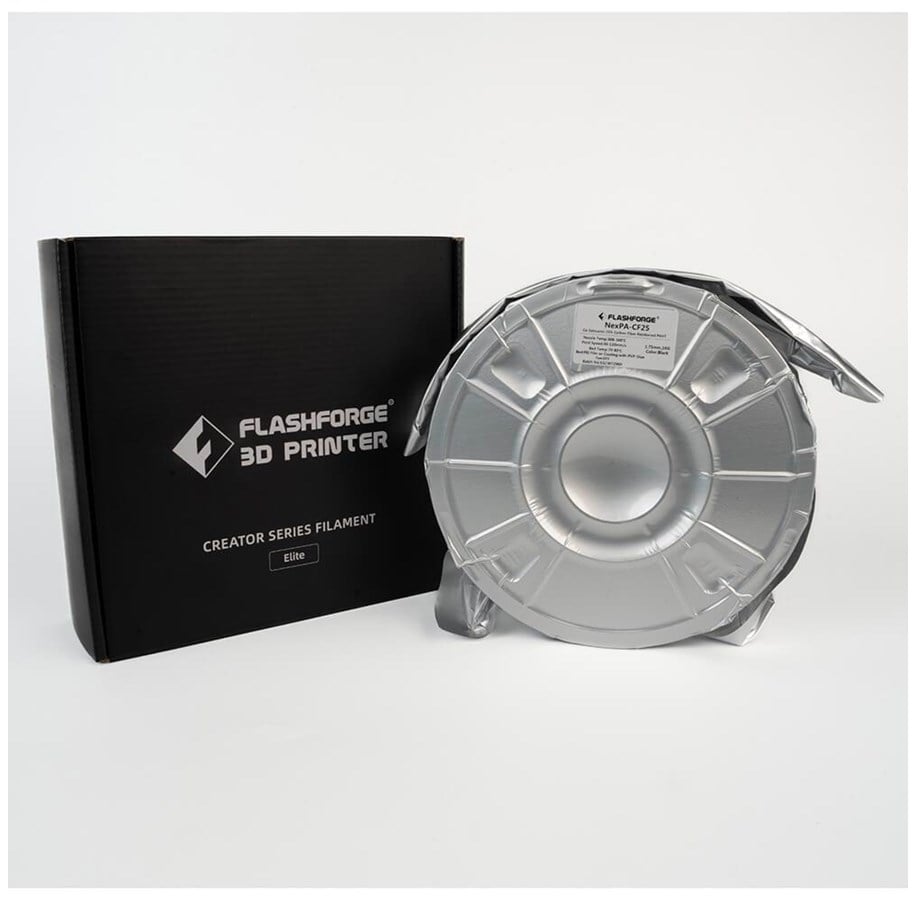
FlashForge NexPA-CF25 1000g - 3D Printing Filament
NexPA-CF25 - NexPA-CF25 to wysokowydajny filament nylonowy wzmocniony w 25% włóknem węglowym, wykonany w technologii współwytłaczanej struktury „skin-core”. Zewnętrzna warstwa zapewnia silną adhezję międzywarstwową, a rdzeń zawiera cięte włókna zwiększające wytrzymałość i odporność na temperaturę. Konstrukcja ta poprawia adhezję w osi Z, właściwości mechaniczne i stabilność wymiarową oraz zmniejsza zużycie dyszy. Idealny do cienkościennych, obciążonych i wytrzymałych części technicznych.
- Waga: 1 kg.
- Długość: 355,3 m.
- Średnica: 1,75 ± mm.
Gęstość (przy 21,5 °C): 1,17 g/cm³.
Odporność na temperaturę: 147 °C. przed odkształceniem
- Szpula: 200mm Średnica zewnętrzna & 53mm Średnica wewnętrzna & 63mm Wysokość, W plastiku
Printing filaments take advantage of the general laminar flow of polymeric fluids during extrusion and maintain the stable skin-core structure even after the filament passes through the nozzle of the printer. This technology contributes to the excellent Z-axis interlayer adhesion of FDM fiber-reinforced filaments because the major layer adhesion comes from the outer shell rein without fibers.
Meanwhile, 25% chopped cabron fiber content can improve the mechanical properties and heat resistance of the printed parts.
Co-extrusion ‘skin-core’ structure
The new generation of industrial 3D printing filament features a skin-core structure. The outer 'skin' is a modified resin with high layer adhesion, and the inner core is reinforced resin containing high chopped fiber content.The co-extrusion skin-core technology has greatly increased fiber content while maintaining the toughness of the filament and thus improved the mechanical properties and heat resistance of the printed parts.
Excellent layer adhesion
The 3D printing filaments have taken advantage of the general laminar flow of polymeric fluids during the extrusion and maintain the stable skin-core structure even after the filament passes through the nozzle of the printer. Among many other fiber-reinforced filaments, Z-axis layer adhesion loss is always a common issue during printing. However, for 3D printing filaments, the Z-axis interlayer adhesion comes from the adhesion between the resin of the outer shell and this can completely avoid the layer adhesion loss.
In addition, after being extruded through the nozzle, the inner core and outer layers of the extruded filament are heated, melted and bonded together again. In this way, the adhesion between the inner and outer layers can reach the optimal level and the fibers of the inner core can effectively withstand the force from the z-axis outer layer resin. With these two advantages, the Z-axis interlayer adhesion of final parts printed with these filaments is further improved compared to parts printed with pure resin filaments.
Reducing nozzle abrasive wear
During the extrusion process, the filaments can greatly reduce the wear of the nozzle. The material that contacts the inner wall of the nozzle is made of pure resin which greatly limits the contact between the reinforcing fibers and the nozzle. At the same time, the skin-core structured filament can also avoid the contact between the reinforcing fibers of the filament and extruders or throats, which prolongs the service life of the entire extrusion parts of the 3D printer.
Powyższe informacje / specyfikacje są wskazówkami i mogą zostać zmienione przez producenta bez powiadomienia. Z zastrzeżeniem błędów w druku i obrazów orientacyjnych. Niektóre teksty są generowane automatycznie lub tłumaczone maszynowo i mogą posiadać błędy lub mogą być mylące.