
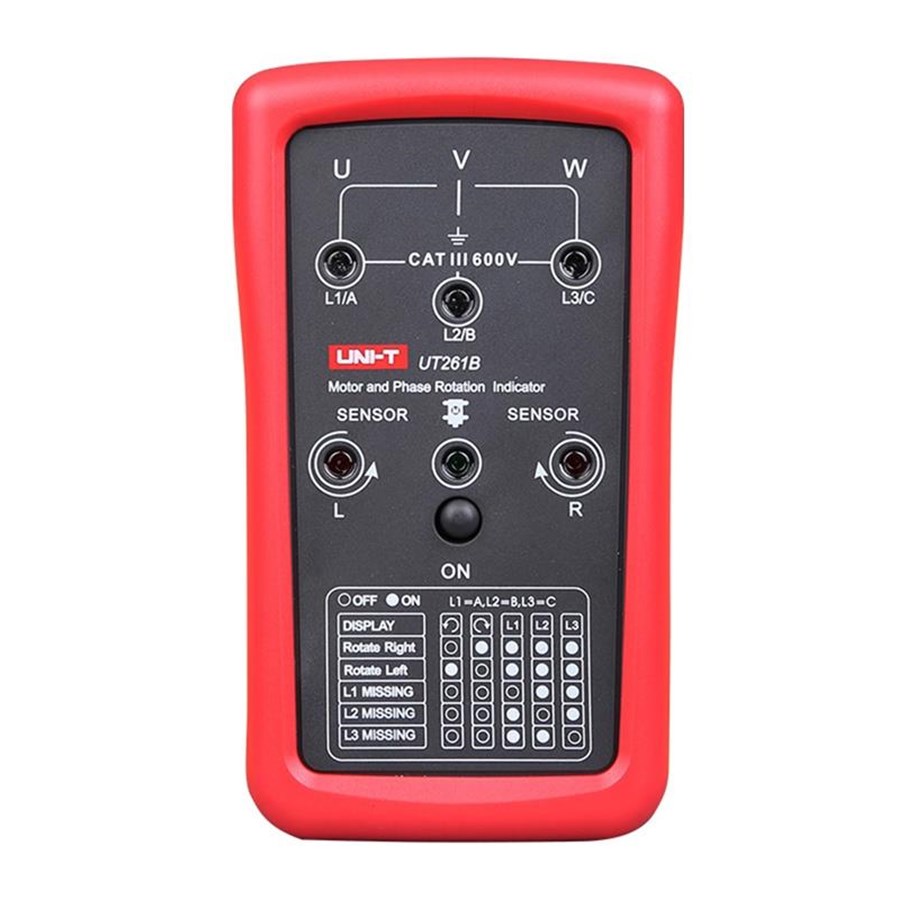
UNI-T UT261B Motor Phase and Rotation Direction Tester
The Uni-T UT261B is a compact tester for checking phase sequence, phase loss, and motor rotation direction in three-phase electrical installations. It operates with AC voltages from 90 to 600 V and frequencies from 15 to 400 Hz, making it suitable for testing electrical systems and drive equipment. LED indicators clearly show the detected phase sequence, phase loss, and motor rotation direction, allowing incorrect connections to be identified quickly. With its compact 123 × 71 × 29 mm design and 180 g weight, the tester is easy to carry and use during installation, maintenance, and troubleshooting.
Clear LED indicators provide an immediate indication of the detected phase sequence, phase loss, and motor rotation direction. The compact housing measures 123 × 71 × 29 mm and weighs only 180 g, making the UT261B suitable for both workshop use and service work on site.
The tester is powered by a 9V 6F22 battery and is supplied with three test leads featuring alligator clips for straightforward connection to the installation. A carrying case provides convenient storage and transport, while the included user manual helps with operation.
Powyższe informacje / specyfikacje są wskazówkami i mogą zostać zmienione przez producenta bez powiadomienia. Z zastrzeżeniem błędów w druku i obrazów orientacyjnych. Niektóre teksty są generowane automatycznie lub tłumaczone maszynowo i mogą posiadać błędy lub mogą być mylące.